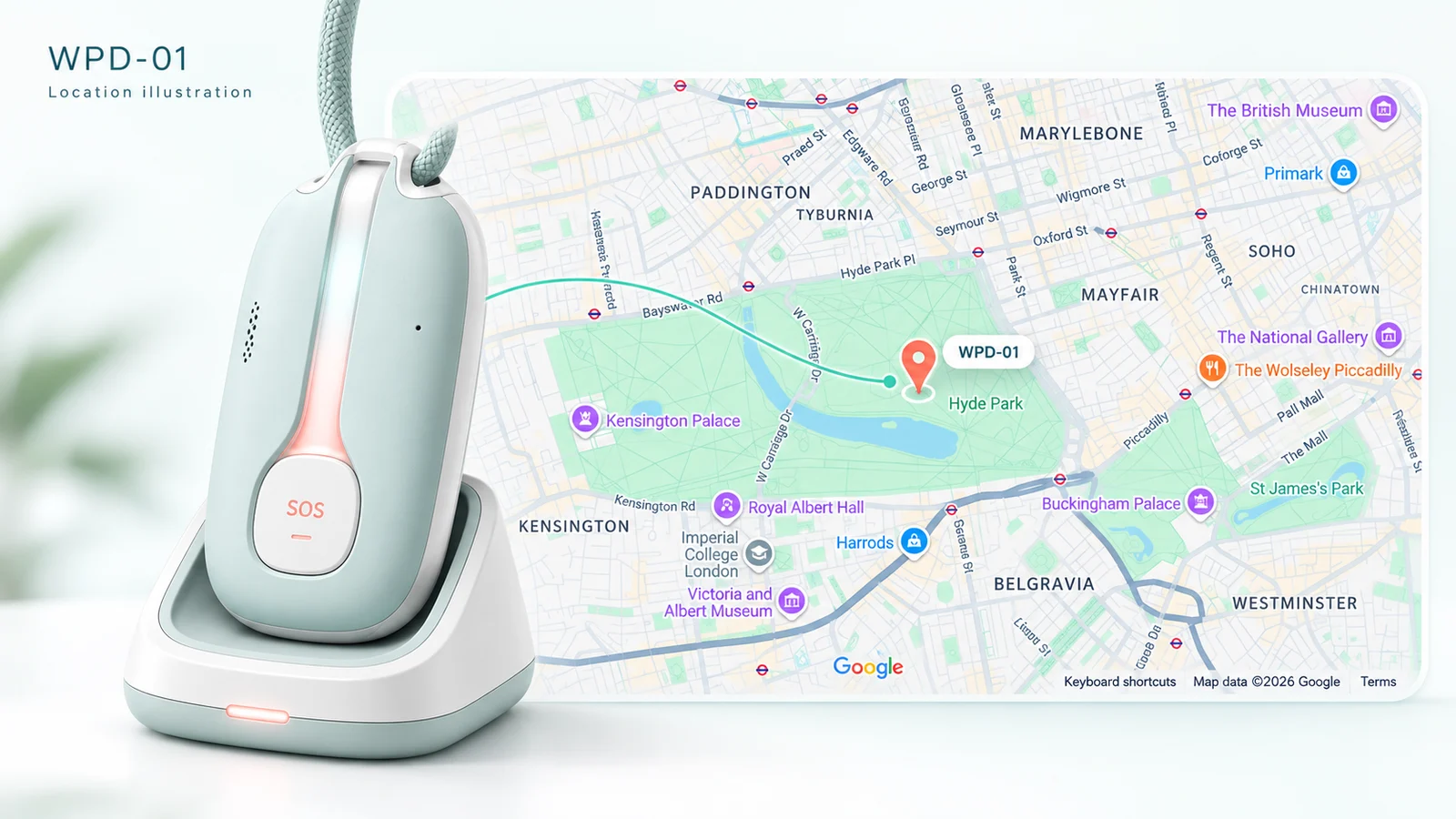
Location information can help an alert recipient understand where a wearer may be. Different positioning methods use different signals and infrastructure. For a telecare project, the useful question is how location behaves in the intended environment and how that information reaches the people responding.
WPD-01 supports GPS, Wi-Fi positioning, BLE positioning, cellular LBS and A-GPS. The explanations below describe the general roles of those technologies. They do not specify a WPD-01 accuracy figure, automatic selection order, reporting interval or platform compatibility.
GPS: satellite-based positioning
GPS uses signals from satellites to determine position. Buildings and other obstructions can limit signal reception; receiver design and the surrounding environment also affect the result. GPS.gov explains these factors in its GPS accuracy guidance. This is why a successful outdoor demonstration should not be treated as proof of equivalent performance indoors.
For a sample evaluation, include the outdoor routes and building surroundings that match your service. Ask how position availability and the age of a reported location will be presented in your proposed configuration.
Wi-Fi positioning: using nearby wireless infrastructure
Wi-Fi positioning generally uses information about nearby Wi-Fi access points together with a location reference or service. It is distinct from providing an internet connection over Wi-Fi. The presence of Wi-Fi hardware does not by itself confirm how a device exchanges data or resolves a location.
For WPD-01, confirm the required services, configuration and behavior in the target buildings. Do not assume that every home router will provide an accurate indoor position. Ask what information is required and how changes in the environment are handled.
BLE: proximity and configured location references
Bluetooth Low Energy can support proximity and positioning applications. A project may use known reference points or beacons, but the required infrastructure depends on the implementation. The Bluetooth SIG overview of location services explains the broader technology category.
WPD-01 supports BLE 5.0 and BLE positioning. This does not establish support for every Bluetooth location technique. Ask Amulink to confirm beacon requirements, provisioning and location presentation for your project. Do not infer room-level accuracy or a particular ranging feature from the Bluetooth version alone.
Cellular LBS: a network-based location method
Cellular LBS uses mobile-network information as a location input. It should not be assumed to provide the same result as GPS or a configured indoor system. Network conditions, available reference data and implementation affect its usefulness.
During evaluation, ask which location method produced each result and how the receiving system distinguishes current information from the last available position. Confirm these capabilities with the proposed configuration instead of assuming they are exposed by every platform.
A-GPS and geofencing have different roles
Assisted GPS uses assistance information to support GPS acquisition; it is not a separate guarantee of indoor coverage. WPD-01 supports A-GPS, with service requirements to be confirmed.
Geofencing applies a defined geographic boundary to location information. WPD-01 supports geofence alerts. The practical result depends on the available position and configured rules, so evaluate boundary behavior as part of the project rather than treating a geofence as a physical safety barrier.
What to ask before integration
- Which methods are available in our target country and buildings?
- What SIM service, beacons or external services are required?
- How will recipients identify old or unavailable location information?
- What update behavior and geofence settings can be configured?
- How will location and alert events reach our platform?
Review the WPD-01 technology overview, download the product brochure or use our telecare purchasing checklist to plan an evaluation.
Discuss Technical Integration ↗
Platform compatibility and interfaces are to be confirmed according to project requirements.