Practical guide · Amulink
A connected call is only the start of a useful conversation. When evaluating a personal alarm, telecare teams should check whether the wearer and receiving contact can understand each other in the rooms where the device will be used. This guide focuses on a practical indoor voice test for an Amulink WPD-01 project.
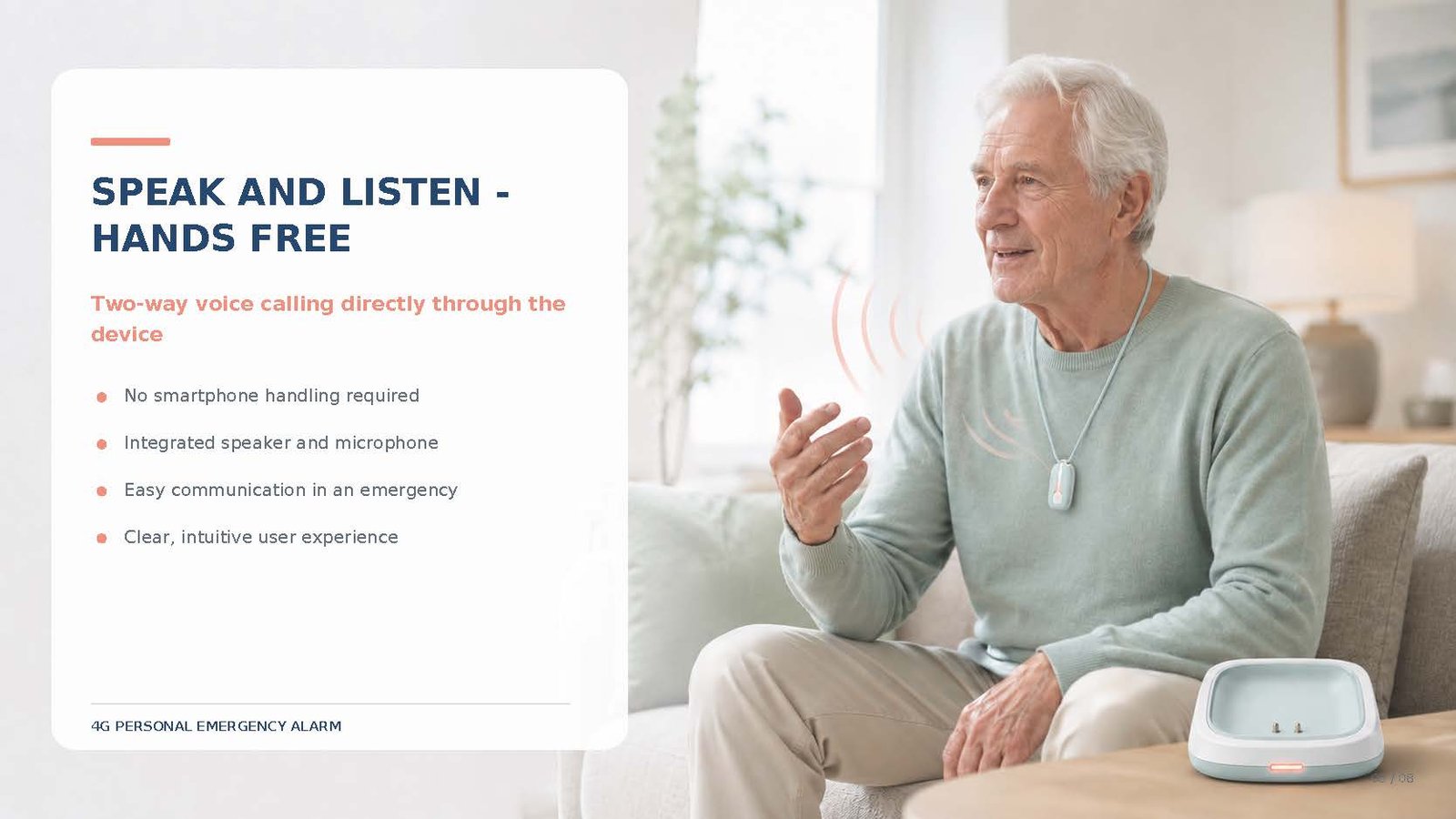
Separate coverage from conversation quality
Ofcom’s indoor coverage guidance explains that building materials can affect mobile reception and that coverage tools provide predictions for a location. An outdoor signal does not establish the experience inside every room.
Use those predictions to plan an evaluation, then test the actual WPD-01, SIM and receiving arrangement in the intended setting. For questions about network and SIM selection, read our connectivity guide. The checks below focus on what the two people can hear and understand.
Arrange a controlled call
WPD-01 includes two-way calling and a manual SOS button. Confirm the configured call workflow with the project team and tell the receiving contact when the test will take place. Use an agreed test destination so practice does not cause an unnecessary emergency response.
Have one participant wear the device as instructed and another answer at the intended receiving endpoint. Start in a quiet room, then repeat in representative locations used by the wearer. Avoid changing several settings at once: a simple baseline makes problems easier to investigate.
Use short, repeatable phrases
Ask the wearer to say a short sentence and have the receiver repeat what they heard. Then reverse the exercise. Include a simple question that requires an answer, rather than judging the call only by whether sound is present.
- Can the receiver understand the wearer at an ordinary speaking level?
- Can the wearer understand the receiver without extra coaching?
- Does either side notice interruptions, echo or repeated words?
- Does the conversation remain understandable with normal background sound?
Use the same phrases across test locations. Do not ask participants to manufacture a distressing situation; the purpose is to check communication in a controlled exercise.
Repeat where the wearer spends time
A bedroom, living area, corridor and shared space can have different reception and sound conditions. Test the relevant rooms and repeat with ordinary sources of noise, such as a television at the wearer’s usual volume. Keep the device positioned as described in the supplied instructions.
A successful call beside a window is not enough if the intended service relies on calls elsewhere in the building. If a location performs poorly, record it and investigate with the supplier or network provider before treating the deployment as ready.
Keep a useful test log
Record the room, date, device identifier, SIM or service arrangement, receiving endpoint and observations from both participants. Note connection failures separately from problems understanding speech. Document any configuration change and repeat the same test afterward.
Agree the acceptance criteria with the service team before rollout. This guide does not set a universal audio score or guaranteed response time. Your decision should reflect the intended environment, users and measured results.
Check the next action after the conversation
Confirm what the receiving contact does when the wearer answers, cannot be heard or does not respond. Record the backup contact and escalation arrangement appropriate to the service. Do not assume a device call automatically reaches emergency services.
Use the How It Works page and product resources for onboarding. Our personal alarm support plan guide covers the broader handover and review process.
Evaluate WPD-01 for your project
Explore Amulink application scenarios or request a WPD-01 sample. Share the intended building, receiving workflow and evaluation goals so the sample discussion addresses your service needs.
Source and editorial note
Ofcom: Improving your indoor coverage (published June 2, 2023; checked October 13, 2026) supplies the general indoor reception context. This is an original practical guide, not recent news. The test process is Amulink editorial guidance. Smartphone features discussed by Ofcom do not establish WPD-01 feature availability or network compatibility.